Half a million visits across two UK lagoons answered the demand question. What closed them was the capital stack, not the queue. Surf X delivers the same wave on a fraction of the balance sheet.
Pre-tender envelope for the wave and the core site.
Break-even
28.2%
Of capacity. The workbook’s Year 1 sits at 27.5%.
Water capacity
28/hr
Surfer slots an hour, 8.5 hours, 290 days.
01 The demand question is answered
People turned up. In numbers. In Britain. In the rain.
Inland surf in the UK is no longer a hypothesis to be funded — it is a trading record to be read. Three lagoons have now run commercially on British soil, and every one of them filled its water.
Lost Shore · Edinburgh
100,000+ in year one
Opened November 2024. Visitors from 67 nations inside twelve months, a reported £18m boost to the Scottish economy and 130 jobs created.
The Wave · Bristol
400,000 since 2019
Roughly 400,000 visits over five and a half years, including around 400 regular para-surfers. Ownership attributed its 2025 shutdown to a financial technicality, not a shortage of customers.
Adventure Parc · Snowdonia
97% first-season occupancy
Britain's first, open August 2015. 14,000 visitors in the opening fortnight and a 97% average booking rate across its first season.
Why this matters more than a market forecast
A demand forecast is an opinion. An operating record is evidence. Surf X is not asking an investor to believe that Britons will pay to surf a machine-made wave in a field — three operators have already proved they will, at £55–£66 a session, year-round, in a climate nobody would choose.
The open question was never demand. It was whether the asset could be built cheaply enough to survive its own debt.
02 The capital question
Every UK lagoon got bigger. And more expensive. And more fragile.
Nine years separate Britain's first inland wave from its newest. Over that span the wave barely changed — the capital behind it multiplied five-fold.
Capital cost per UK inland surf asset
Reported build cost · £ millions · year opened
Existing UK lagoonsSurf X Site 1 — pre-tender target
Build costs as publicly reported. Surf X Site 1 is a pre-tender allowance, not a quotation — the build-up is set out in section 09. Snowdonia and Bristol have both since passed through insolvency and changed hands; both are trading again under new ownership.Table view
Asset
Build cost
Opened
Subsequent history
Adventure Parc Snowdonia
£12m
2015
Wave machine off 2022; closed Sept 2023; reopened Sept 2025, new owner
The Wave, Bristol
£26m
2019
Administration June 2025; reopened weeks later, new owner
Lost Shore, Edinburgh
£60m
2024
Trading; 100,000+ visitors in year one
Surf X Site 1
£2.8m
target
Pre-tender allowance — see section 09
The pattern, stated plainly
Two of Britain's three inland lagoons have been through an insolvency process. In neither case was the stated cause an empty lagoon. Bristol had taken roughly 400,000 visits and its owners attributed the shutdown to a financing technicality; Snowdonia's wave machine had been switched off for a year before the gates closed. Both assets were wanted enough that new owners reopened them.
That is an encouraging reading, not a grim one. It says the product works and the public shows up. It also says that a £26m–£60m capital stack leaves an operator no room for a soft quarter. Build the same wave for under £3m and the arithmetic stops being fragile.
03 What we actually build
Start with the wave. Add only what the wave pays for.
The destination model spends its capital on land, hotel and hospitality before the attraction earns a pound. Surf X reverses the order: the lagoon goes in first, and every further pound has to justify itself against visit frequency, dwell time or spend.
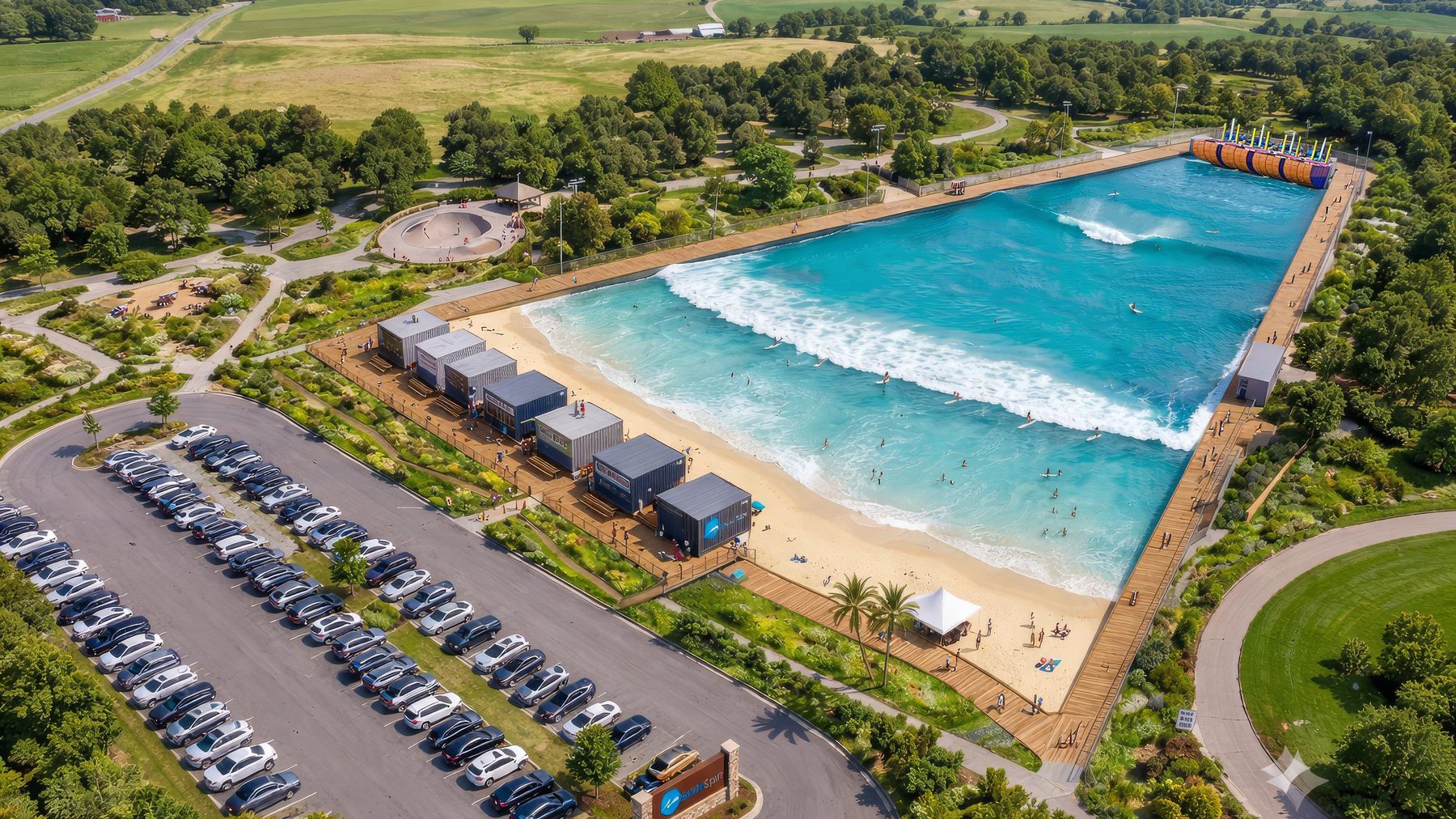
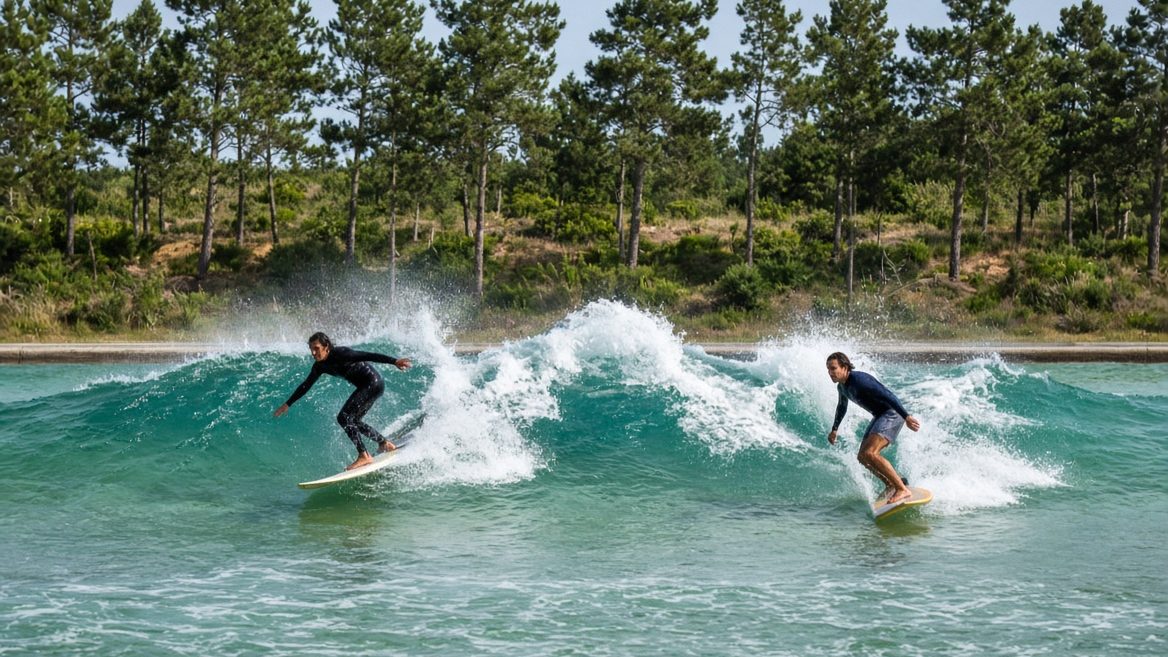
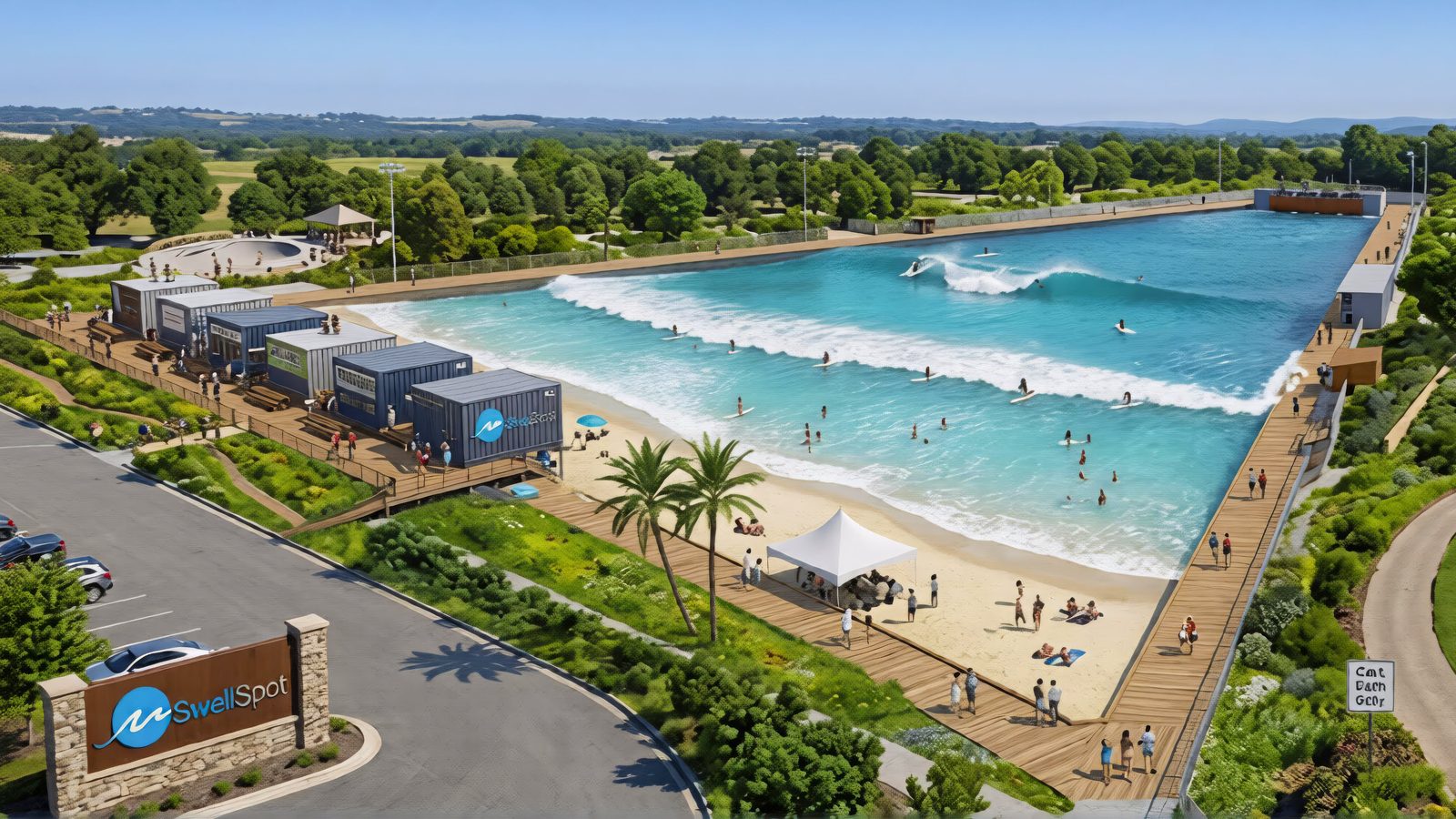
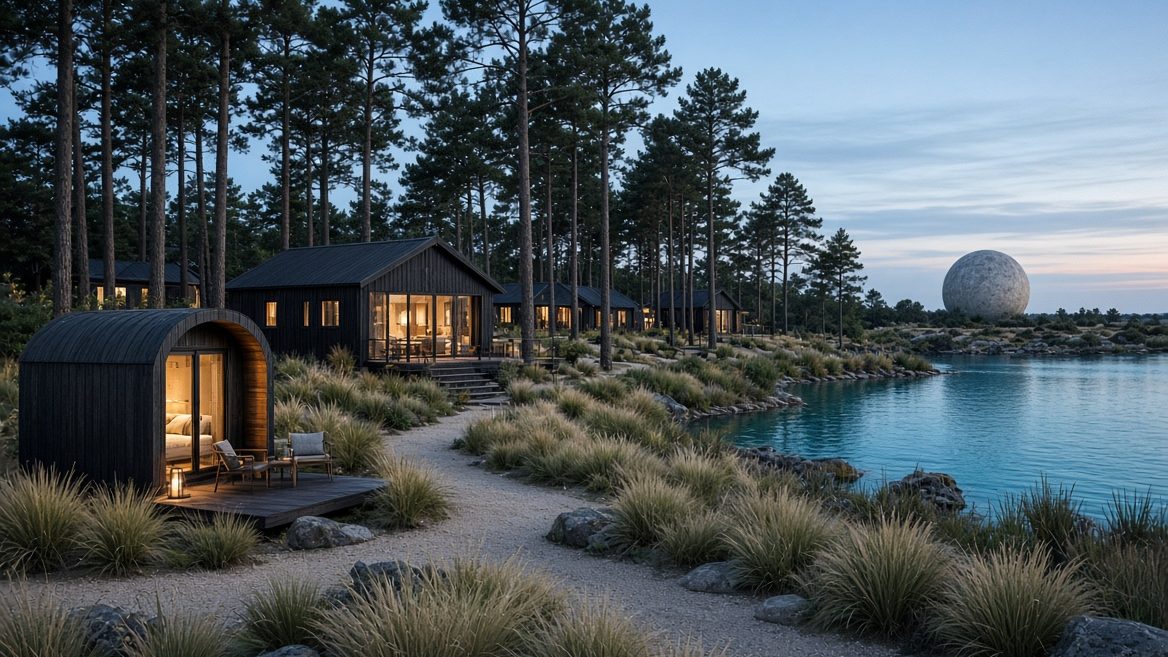
The siteindicativeLeft and right, one peakphotographBeach edge and shackindicative
The wave earns the visit
Four plungers. One A-frame.
A compact single-sided lagoon breaking left and right, programmed from first-timer to advanced. This is the asset customers pay for — so it is the asset we build first.
Phase 1 stops at the water's edge
£2.8m buys a trading site
Wave plant, lagoon, treatment, power, changing, board store, snack shack and parking. Enough to open, take bookings and start generating real operating data. Nothing more.
The platform repeats
Site 1 produces the data
Utilisation, yield, repeat rate and energy draw from a live site. Site 2 is then underwritten on evidence rather than on belief.
Cabins come out of trading cash, not out of the raise.
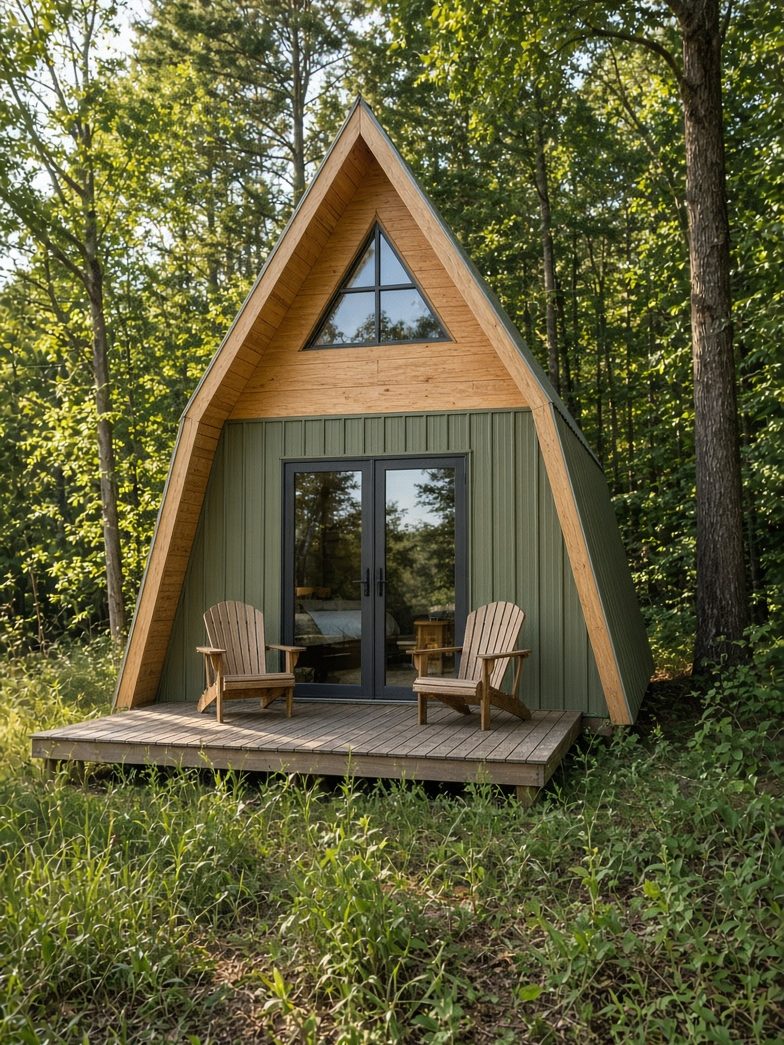
Twenty compact cabins turn a surf session into a weekend — and they are the single easiest thing to over-build. So they sit in Phase 2, released once the water is trading and the occupancy case is evidence rather than an assumption.
A-frameindicativeCabins and pods by the waterindicative
Why it is phased
The wave is the risk that must be retired first
Cabin capital added to Phase 1 would raise the ticket by roughly 40% to buy revenue that only exists once the lagoon is drawing people. Holding it back keeps the Phase 1 raise small and the break-even low.
What it adds
One customer, more than one transaction
Surf, food, drink, a bed, breakfast, surf again. Longer dwell, second-day sessions, group and membership weekends. Stay revenue is excluded from the live model on the next page until rate and occupancy are evidenced.
05 Gravity
Site 1 is the ask. Gravity is the ceiling.
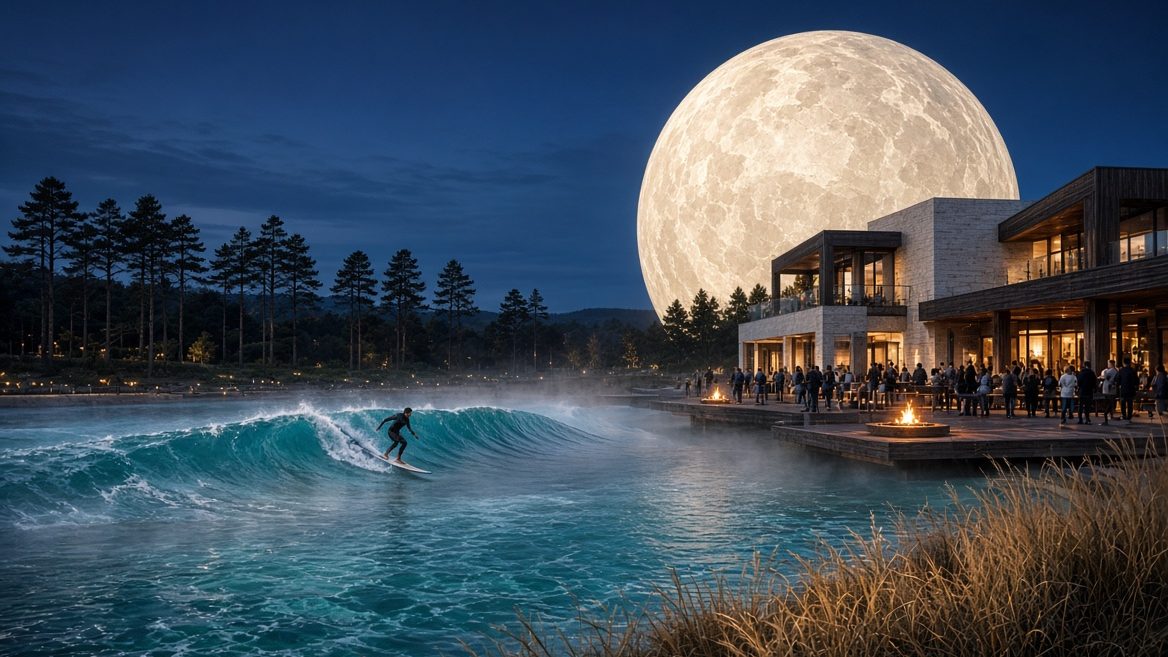
Gravity is the destination-scale expression of the same platform — architecture, hospitality, night programming. It is shown here so the direction of travel is visible, and for no other reason. None of it is in this raise, and none of its capital sits in the £2.8m.
In the raise
Site 1, Phase 1
Four plungers, a compact single-sided lagoon, changing, board store, shack, parking. £2.8m. That is the whole ask.
Not in the raise
Gravity, and the cabins
Destination architecture and hospitality are a later decision funded on later evidence. The twenty cabins are Phase 2, out of trading cash.
Real at Site 1 today
The floodlit evening
Lit sessions are the one destination-feeling thing Site 1 already has. The 8.5-hour operating day in the model depends on them, and the lighting load is costed in.
06 The third product
The same plunger array, in a private garden.
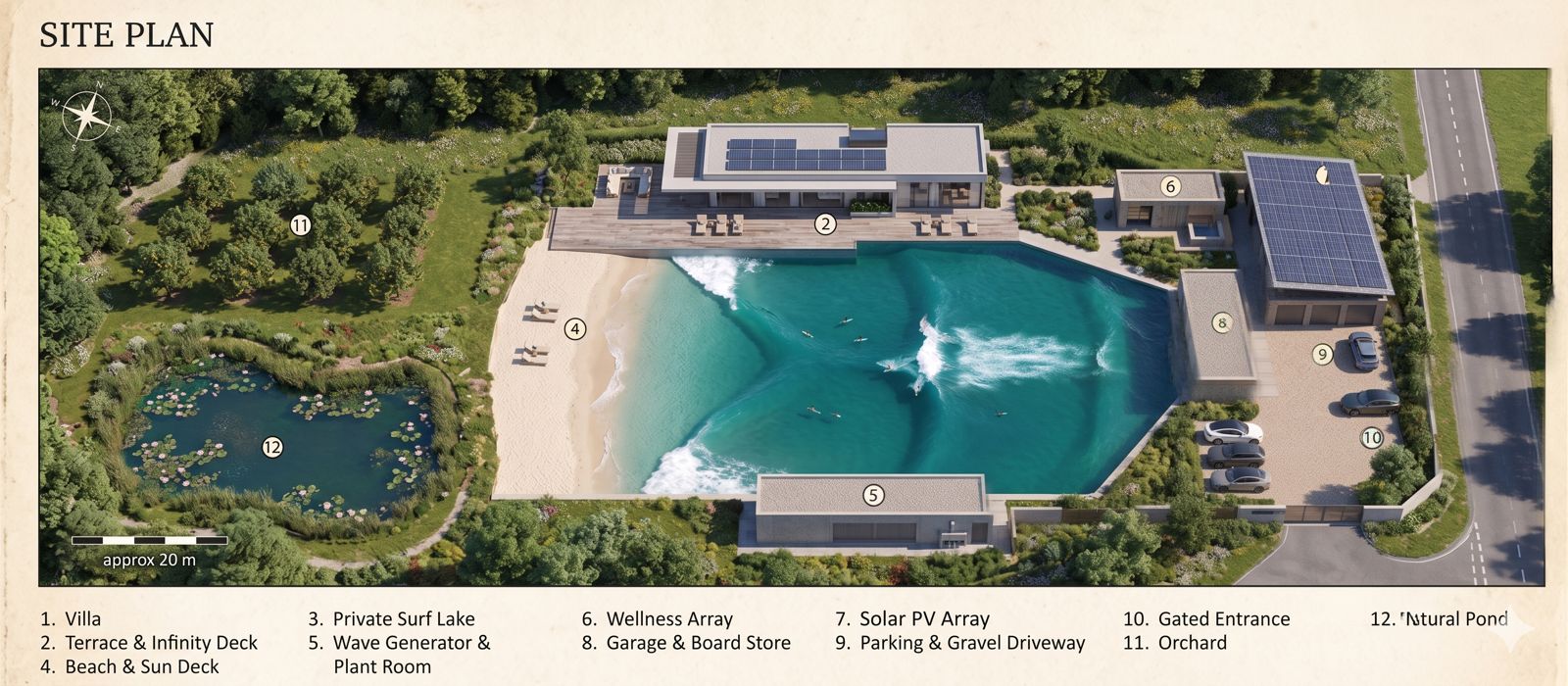
The technology does not only scale up. SwellSpot's published residential configuration puts a full peeling wave on roughly an acre — which turns a compact lagoon into a private amenity for an estate, a lodge resort or a single house.
Private surf villa — indicative site planscale bar 20 m
A villa lagoon is not a scaled-down surf park. It is a different customer entirely: no ticketing, no lifeguard rota, no car park. The wave becomes part of the property — the way a pool or a tennis court is, at a size that still produces a real ride.
For Surf X, it matters for three commercial reasons. It shortens the sales cycle, because a private buyer needs no planning consent for a public attraction. It proves the plant at small scale on a paying installation. And it puts the same four-plunger array in front of exactly the people who invest in the larger sites.
ConfigurationPrivate surf lake, A-frame, both directions
FootprintAbout 1 acre of water
Published ride lengthUp to 75 yards
On-site generationRooftop PV array + plant room
Supporting buildVilla, terrace, beach deck, board store
StatusConcept — costed on enquiry
Stated honestly
The site plan above is an indicative design, not a built installation, and the villa tier carries no price on this page. SwellSpot has publicly quoted residential figures in the past, but those numbers are several years old, dollar-denominated and pre-date current UK construction costs — republishing them here would be misleading. The villa is costed per enquiry against a tendered scope.
07 The technology
A mechanical plunger array, and the one thing still to prove.
SwellSpot generates waves with hydraulically driven plunger modules firing into a shaped basin. It is mechanically simpler than a foil-and-track system, it is patented, and its published energy numbers are the reason Surf X chose it.
Wave height, standard configuration
3–6 ft
Maximum face height
8 ft
Swell interval
8.5–12 s
Ride length, residential config
75 yd
Energy per rider (published)
0.93 kWh
Energy per wave (published)
3.75 kWh
Issued patents
11
Patents cover plunger wave generation, artificial reef design, rip-current mitigation and lagoon construction. Wave size, shape, frequency and direction are set in software, so one basin serves a beginner lesson and an advanced session on the same afternoon.
Open item — technology validation
SwellSpot has issued patents and a detailed engineering specification. What it does not yet have in the public record is a commercially operating reference lagoon at full scale. Any investor diligence will find that, so this page states it first.
Surf X's answer is structural rather than rhetorical: plant performance is a commissioning gate, not an assumption. Wave height, interval, ride length and rider throughput are contracted performance requirements, tested and signed off before the site opens to paying customers. Capital is released against that test, not ahead of it.
Where Surf X has an unfair advantage
At a published 0.93 kWh per rider, energy is a small line in this model — roughly £62k a year at Site 1 scale, against a £960k cost base. Skyline DC Energy designs and operates hybrid distributed energy systems, and CrestIQ monitors them. On-site generation and live plant optimisation are in-house capability, not a procurement risk.
08 The live model
The model starts with water, not with a revenue target.
Physical capacity, then commercial utilisation, then realised spend, then real cost. Move any input and every figure on this page moves with it. Nothing is hard-coded.
Reconciled against model.js and the August 2026 workbook
Membership was counted twice. In model.js, surfRev prices every paid visit at the blended yield and memberRev is then added on top — but a member session is one of those visits. At 20 sessions per member that overstated Year 1 revenue by about £205,000. This model removes member sessions from the pay-per-use count before pricing them, then adds the fees back as their own line.
Break-even did not match its own revenue line. The published figure came from opex / (capacity × blended), which ignores membership and ancillary altogether and reads 33.1%. Solved honestly against the revenue the same file produced, it was 21.9%. Two errors pulling opposite ways. Reconciled, on a consistent basis, it is 28.2%.
The workbook and the code disagree on Year 1. The README records a Year 1 utilisation of 27.5%; model.js and site.js both run 42%. This page opens on the workbook figure, because it is the lower of the two and it is the one that was written down. The buttons below switch between them.
Practical capacity
—
Paid visits, Year 1
—
Revenue
—
EBITDA
—
EBITDA margin
—
Break-even utilisation
—
Return on capital
—
Simple payback
—
Where Year 1 sits against break-even
Share of practical water capacity
Headroom is the distance between the two markers. Anything to the left of the red line does not cover Year 1 operating costs.
Distance to break-even
Each lever on its own, everything else held at the current case
Lever
Current
Break-even
Move required
—
The yield assumption is conservative — by your own price list
model.js carries a session mix of 20% beginner at £28, 20% intermediate at £40, 55% advanced at £60 and 5% premium at £90. That mix blends to £51.10. The model never uses it: useMixPrices is false, so a flat £42 is applied instead — 18% below your own price list.
It is the difference between a marginal first year and a comfortable one. On £51.10, break-even falls from 28.2% to 24.5%, and the workbook’s own 27.5% Year 1 produces about £119,000 of EBITDA instead of a small loss. The defensible position is to raise on the flat £42 and hold the mix as the upside you argue once the site is trading — which is exactly what the model already does.
From water to revenue
How practical capacity becomes Year 1 income
Step
Visits
£
Basis
Capacity = 14 surfers × 2 sessions/hour × 8.5 hours × 290 days. Member sessions are removed from the pay-per-use count before the blended yield is applied, then membership fees are added back as their own line.
When a membership stops being accretive
Effective yield per member session vs a £42 pay-per-use blend
—
09 Where the money goes
Allowances now. Tendered packages before anyone commits.
Neither table below is a quotation. They are pre-tender allowances built from first principles so that a reader can interrogate the shape of the cost base rather than take a single number on trust.
Lagoon civils, liner, reef bathymetry, balance tank
£600,000
Water treatment and filtration
£150,000
Grid connection, plant room, energy and controls
£170,000
Changing, board store, snack shack
£160,000
Parking, access, landscaping, fencing
£120,000
Professional fees, planning, pre-opening
£190,000
Contingency and working capital
£190,000
Phase 1 pre-tender envelope
£2,800,000
The wave plant line is the workbook’s own £1.22m midpoint, carried across unchanged. The twenty cabins are Phase 2 and are not in this envelope. Two things to watch: contingency at £190k is 6.8% of the total, thin for a first-of-type build; and the workbook’s stated working envelope was £2.0m against a £2.1m raise, so £2.8m is an increase of roughly £700k that will need its own explanation to anyone who saw the earlier pack.
Operating cost — Year 1
Full-year run rate · model.js baseInputs
Payroll — coaches, lifeguards, front of house
£400,000
Energy
£100,000
Rent / site cost
£100,000
Maintenance
£75,000
Marketing
£75,000
Insurance
£60,000
Admin
£60,000
Operating contingency
£50,000
SwellSpot licence royalty
£40,000
Year 1 cost base
£960,000
These nine lines are the workbook’s own cost base, not a reconstruction. Two observations. The energy line carries £100,000; SwellSpot’s published draw at four-plunger scale over 2,465 operating hours at 22–30p per kWh comes out nearer £62,000, so there is headroom there before on-site generation is even counted. And the £40,000 royalty is a licence cost that scales with the platform — worth naming explicitly, because it is the line an investor will ask about and it does not appear in any comparable operator’s accounts.
What moves the answer
EBITDA sensitivity to a 20% move in one input · base case
Favourable 20% moveAdverse 20% move
Utilisation is the dominant lever, which is why it is the one input this model refuses to assume. Cost discipline matters, but it cannot rescue an under-used lagoon — and that is the whole argument for building the cheapest credible wave rather than the largest one.
10 Sequencing
Capital follows evidence, in this order.
Each risk has a retirement mechanism and a status. Where something is not yet retired, it says so.
SiteIn progress
Screened on catchment, access and planning history; retired at heads of terms with a named site.
DemandSubstantially evidenced
Three UK lagoons have traded. Retired further at Site 1 through local catchment analysis, pricing tests and a founding-membership pre-sale opening six months ahead of opening.
TechnologyOpen — gated
No full-scale commercial SwellSpot reference exists in the public record. Retired through contracted performance requirements and a commissioning test that precedes commercial operation.
CapexIn progress
Allowances today; retired through design development, competitively tendered packages and a held contingency.
EnergyIn-house
Measured plant demand, utility review and designed hybrid architecture through Skyline DC Energy, with CrestIQ monitoring.
OperationsIn progress
Operating plan, recruitment, training and pre-opening procedures ahead of first paid session.
Year 1 headroomOpen — the weakest line
The workbook’s own Year 1 does not clear its costs. At 27.5% utilisation, a £42 blend and 250 members it produces roughly −£24,000 of EBITDA against a 28.2% break-even — short by 0.7 points of capacity, which is about 505 visits across a whole year. model.js’s own downside case (30% utilisation, £38 blended, 180 members, costs up 8%) is a £108,000 loss. The raise is not sized to that, and saying so is the point of this page. What is modelled but not contracted: a founding-membership pre-sale opening six months before launch, a phased cabin release, and the advanced-weighted price mix already sitting unused in the model.
11 Who delivers it
We know what we own, and when to bring specialists in.
Surf X
Makes it a business
UK development, commercial model, infrastructure, delivery and operations. Scott Graham.
SwellSpot
Makes the wave
Wave technology, engineering, controls and commissioning. Walter Bennett.
Specialist chain
Energy, data, consents
Skyline DC Energy for hybrid energy. CrestIQ for performance intelligence. Planning, civils, water, safety and hospitality partners as required.
12 The conversation
Bring the hard questions. The model is built to take them.
For leisure operators, property and infrastructure partners who already know what a repeat customer is worth — and for investors who would rather see a sourced downside than a polished upside.
The Wave Bristol build cost, visitor total and 2025 closure — Surfertoday; reopening under new ownership — SoGlos
Adventure Parc Snowdonia cost, capacity, first-season occupancy and ownership history — Wikipedia
SwellSpot wave specification, energy figures and patent portfolio — Surfertoday; residential configuration and reference-plant status — Wave Pool Magazine